
From Concept to Fulfillment: The Complete Kickstarter Journey
A realistic Kickstarter campaign timeline can help you plan for everything from pre-launch testing and audience building to launch day, backer communication, and what comes next.


You have a product, a planned launch date, and a to-do list you suspect is incomplete.
At TCF, we work with creators launching physical products on Kickstarter, and our campaigns start with the same kind of document: a day-by-day project timeline that extends from the first kickoff meeting until backers have submitted their shipping addresses.
That timeline spans roughly 115 days, with some post-campaign work extending even further.
Many creators focus on planning for the live campaign, but press outreach, influencer engagement, audience testing, creative production, and lead warming should all begin well before launch. Failing to prepare properly can make an otherwise promising campaign much harder to execute.
Below, we’re sharing the full timeline we use, from the pre-launch phase through what happens after the campaign ends. The stages here overlap intentionally: you might test ads while your video is still being edited or approach journalists before your campaign page is completed.
The goal isn’t to finish one stage before moving on to the next. It’s to give every part of your Kickstarter campaign the time it needs to succeed.
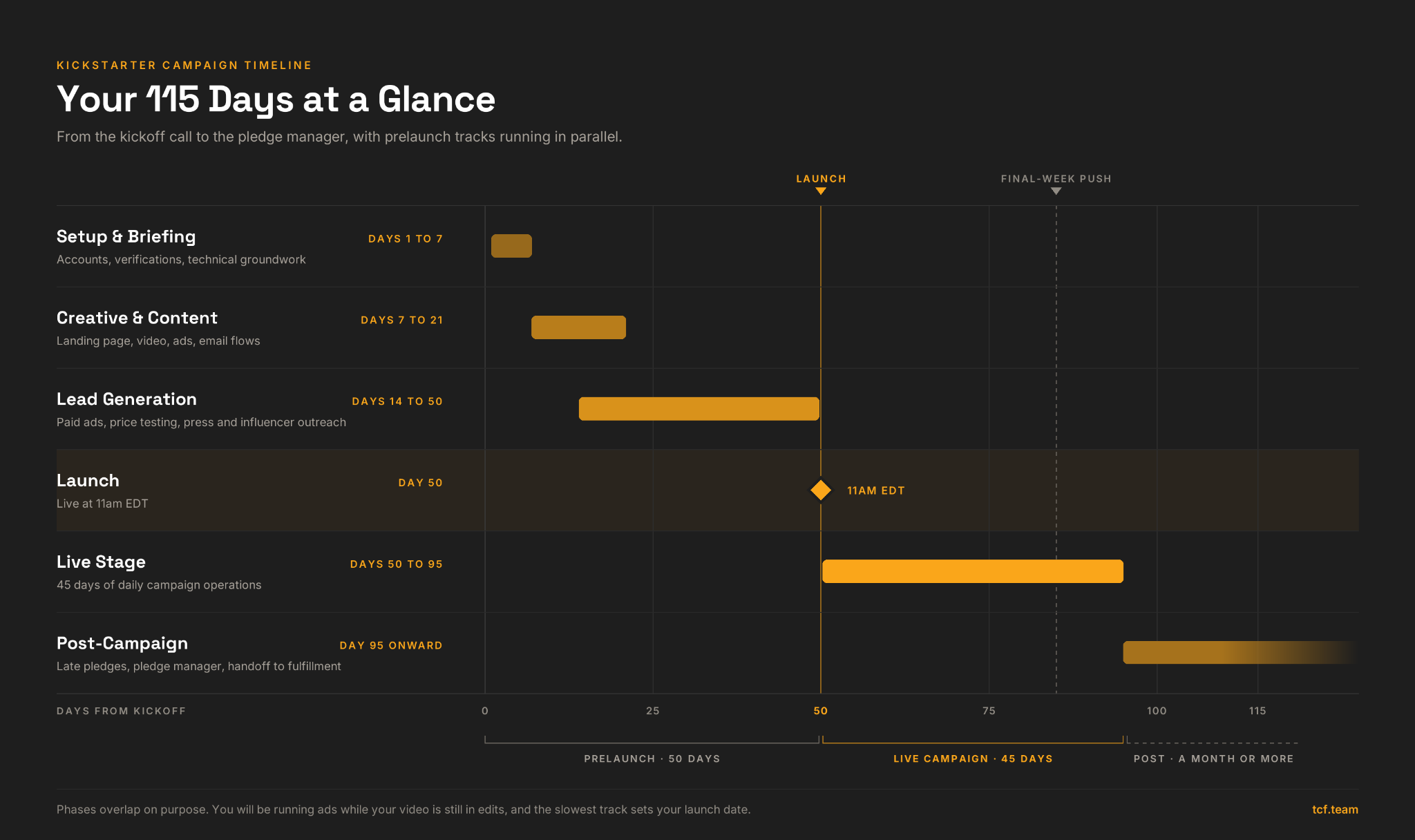
Days 1 to 7: The Paperwork That Can't Wait
Almost no one tells new creators this: you have to show the Kickstarter platform a continuous, unedited video of your product in operation, from beginning to end, before they approve your project. No cuts, no music, and no marketing enhancements. It only takes an afternoon to film, which is why it's important to do it in the first week rather than finding out about the requirement in the sixth week.
The first week includes several examples of this kind of item: easy to do but able to block things that come after it.
- Your Kickstarter business page, with your company's bank details and your own ID submitted for verification
- Your Kickstarter prelaunch page, activated now so it can gather followers while you build everything else
- Fresh domains and email addresses for the campaign, with DKIM and DNS records configured so your emails reach inboxes instead of spam folders
- An email marketing platform set up
- A written marketing brief: specs, features, your story, and first market research
- Every photo, render, and video you already have, gathered in one place
- That uncut product video
It's worth taking a closer look at the prelaunch page, since it starts benefiting you as soon as it is uploaded. After it goes live, your project will appear in Kickstarter's 'Launching soon' section, so people who are already browsing in your category can follow you naturally before you've spent a single dollar on marketing.
When the project goes live, Kickstarter automatically emails these followers. This gives you a launch-day point of contact through the platform itself, with an audience that has opted in on its own. Each additional week the page stays up is another week for followers to accumulate, which is why it makes sense to activate the page in week one rather than waiting until your creative is ready.
Most of the first week involves waiting for the systems to check you, so start the timers early.
The biggest error this week is one project manager, Yeva Gasparyan, points out to both experienced creators and those just getting started: starting preparations too late.
The four areas that always take longer than people are willing to allow are press outreach, influencer sampling, validation testing, and lead warming. A journalist who needs your product in hand three weeks before going live cannot be rushed, regardless of how good your pitch is, and all of these areas should be underway by day 14.
Days 7–21: Build the Things That Do the Selling

During the next two weeks, you’ll assemble the core materials that will explain your product and support your campaign:
- Creating a landing page for lead generation
- Developing multiple versions of ad copy and visuals for testing
- Producing a promotional video
- Designing a survey to identify and understand your leads
- Setting up an automated email sequence
- Compiling a list of your add-ons, including prices and photos
- Gathering sketches and production photos for your campaign page
- Planning out backer community newsletters to distribute at launch
If budget constraints force you to prioritize at this stage, we suggest directing resources toward strong visuals.
A single hero image simply isn’t enough to support a campaign page, ads, an email sequence, and weeks of social content. The standard also increases by product category: a wearable must be shown on a person's body, a kitchen or home product needs to be placed in real interiors, and a design-focused product requires lifestyle and contextual images.
Email is another asset creators sometimes overlook. If you gather leads for weeks and send them nothing until launch day, you miss an opportunity to build familiarity and trust.
Use that time to introduce the team, share development updates, show behind-the-scenes material, and answer any potential backer questions before they pledge.
Days 14 to 50: Find Out What Strangers Will Pay
The landing page and first ads launch around day 14, then you continue driving traffic for five weeks without interruption.
Over those five weeks, you should end up with two things: a list of leads and solid evidence regarding who wants your product and what they will pay for it. Most creators finish this stage with only the list.
At this stage, creators often make a critical mistake, which Yeva observes repeatedly: they conflate lead generation with genuine validation. While building an email list shows that people are willing to share their contact information in exchange for a discount, this metric offers limited insight into whether potential backers will commit at full price.
True validation tests three fundamental aspects that are often overlooked:
- Is the problem genuine, and how many people suffer from it? Entrepreneurs believe there is a large market because the product addresses a problem they experience. The actual number of people affected is usually smaller than the founders' conviction.
- What are people willing to pay? One finding that has surprised creators is that people often accept a higher price than they are willing to ask. Underpricing can cause just as many issues as overpricing. Test against real traffic, and let the data help you set a price that protects your margin without pushing customers away.
- Which product presentation works best? Product presentation can vary, and different approaches may work better than others. Identify that low-cost framing early, rather than trying to find it once you've started the full campaign and ad spend.
As the advertisements are running, the long-lead activities continue: the media kit and press release are completed, deals with influencers are finalized, and samples are shipped. Allow up to a month between sending a sample and seeing a post. You can send samples to major media on the same timescale, with direct contact with journalists starting around day 40.
If you're a small team and can't manage all aspects, protect three things: the ads, the email sequence, and the sample shipments, since these have deadlines you can't delay.
Day 50: Launch at 11 am Eastern

You launch at 11 am EDT, and the time is deliberate: mid-morning Eastern catches North America awake and Europe still online, and your first hours' velocity shapes how Kickstarter's algorithm treats your project.
That is why the biggest mistake with the launch window is sending a single email. During the first 48 to 72 hours, activate all the channels you have built in the prelaunch phase:
- Email to your entire list on day one, with the segmenting saved for your follow-up sends
- A Kickstarter update, which reaches your followers and past backers
- Kickstarter direct messages to your past backers, if you have run a project on the platform before
- SMS, if you collected permission
- Your social channels and community
Coordinating outreach across multiple channels can drive a surge in early engagement, helping your project gain visibility in Kickstarter's recommendations and search results.
On your first day, consider one more move: give someone a small gift or add-on when they pledge during the early hours, and ask them to leave a comment when they do.
The gift encourages early pledges, since one of Kickstarter's earliest signs of success is how quickly support comes in at the start. Strong early figures can help your project appear to more people browsing the site and in its recommendation system.
The comment request does two things: it fills your comments section with sincere positive reactions, which can influence visitors who read the comments before deciding, and it adds another form of engagement to the campaign.
Days 50 to 95: The Long Middle
For the next 45 days, check the ad numbers every morning and shift your budget to what’s working, reply to comments and messages, track cancellations, post your content, and read the feedback your backers are giving you.
The next day, you do the same again. On our campaigns, this process runs alongside press outreach, coordinating with influencers, sending backer updates, arranging newsletter placements, carrying out cross-promotion swaps with other active campaigns, and pitching Kickstarter for a 'Project We Love' badge once early momentum is evident.
Your daily figures will level off at some point during the middle weeks. Coming immediately after the launch spike, this can throw creators into a spin. The plan anticipates this phase: stretch goals are introduced, cross-promotions increase, and flash promotions and limited-time tiers launch. The slowdown is a normal stage and has prearranged remedies.
Three things can significantly impact funding during this period.
First, consider average order value. Although the number of backers draws attention, order value ultimately determines your total. Watch which add-ons are selling, then create bundles that are appealing on their own. For products in the $100 to $200 range, increasing average order value is often a more practical way to reach a large total than focusing on unit volume.
Second, don’t settle too firmly on the prelaunch plan once better information starts coming in. Read your Kickstarter surveys, comments, and conversations with potential backers. For one of our campaigns involving a dog toy, live feedback kept bringing up requests for a smaller size, so we included that as a stretch goal. That led to sales from a group that hadn’t appeared in months of prelaunch research.
Finally, don’t spend your entire advertising budget at the beginning. The final days can bring some of the best return on ad spend of the campaign. Urgency is real, social proof has peaked, and people who were on the fence finally decide. Creators who spend heavily in the first few weeks can reach that point with no money left.
The final-week countdown begins on day 85 across all channels, so keep some of your budget in reserve.
Day 95 Onward: The Money Hasn't Arrived Yet

The campaign will end, but some stages remain open for weeks longer than most people expect.
First, late pledges. Kickstarter lets you keep taking pledges after the clock stops, and it rewards you for treating this as a real stage, not an afterthought. Give it a proper run, roughly a month, so traffic still arriving from press coverage, influencer posts, and word of mouth has somewhere to convert. Then look at what it’s actually producing and decide whether to keep it running. Campaigns can close with more momentum than their creators expect, and switching the lights off the day the timer hits zero throws that away.
This is also the time for a final performance review. Go through all the channels you ran, since those numbers can guide your ecommerce store, your next campaign, and your ad spending for the coming year.
Finally, the pledge manager is where backers confirm their shipping addresses, choose variants, and select add-ons. Setup takes about a week, and the survey should stay open for at least a month. If a backer never completes the survey, you cannot ship their package, which is why you may need to send several more weeks’ worth of reminders.
Before You Set a Date
The numbers to plan around, one more time:
- Kickoff to pledge manager: 115 days. About four months of real, staffed work.
- Prelaunch: 50 days. Setup, creative production, and five overlapping weeks of paid testing.
- Press and influencers: A month or more of lead time. Samples ship long before anything publishes.
- Live campaign: Around 45 days, run daily.
- Post-campaign: A month or more. Late pledges keep selling, and the pledge manager survey stays open while you collect shipping information.
In our experience, the numbers tend to increase rather than decrease. If you keep the launch date in mind and go back 50 days, you will reach the day when the work starts.
Before you decide on a date, remember that the launch window isn't solely within your control. The seasonality of your product category, competing product launches, and a delivery date that aligns with periods when your target audience is most likely to make gift purchases can all affect the optimal launch date.
If the crucial 50-day deadline has already passed, consider postponing the launch. While this may initially seem discouraging, our experience shows that a campaign launched at the optimal time, with thorough preparation and a complete timeline, can outperform one rushed to meet an arbitrary target date. Prioritizing readiness over an initial launch date can increase your likelihood of long-term success.
TCF Team is a crowdfunding marketing agency and Kickstarter Premier Partner supporting physical product creators from validation through launch and scaling.
