
From Side Project to Award-Winning Studio: How Mighty Boards Built a Business on Kickstarter
What began as a shared passion for tabletop games has grown into an internationally recognized studio. With Rebirth II on the horizon, Mighty Boards reflects on finding its creative identity, building a community, and making games that bring people together.

When the founders of Malta-based tabletop game studio Mighty Boards first joined forces, they weren't necessarily setting out to build a full-fledged publishing company. They were game designers with projects of their own, including Petrichor and Vengeance, looking for a way to bring those ideas into the world.
More than a decade later, Mighty Boards has built a catalog spanning everything from cozy village builders to dungeon crawlers, cultivated a community of players across genres, and earned one of tabletop gaming's highest honors: the Kennerspiel des Jahres award for Rebirth, designed by legendary game designer Reiner Knizia.
Now, the studio is preparing to return to Kickstarter with Rebirth II, an ambitious follow-up that expands on the original's hopeful world and accessible gameplay.
We caught up with Mighty Boards to talk about the studio's unlikely beginnings, the creative philosophy behind its games, and what it takes to build a lasting business through crowdfunding.
From side project to publishing studio
Mighty Boards began taking shape around 2014, when a group of game designers started discussing the possibility of publishing their own games. They had experience designing games but wanted greater control over how their work reached players.
"I'd done Days of Ire first, as a bit of a test, and I was working on Petrichor, the first game I really wanted to self-publish. Gordon was working on Vengeance. That's where we came together and said, 'Let's set up one entity, share marketing resources, maybe get some admin people working for us.'"
They brought art and graphic designer Mark Casha on board and eventually merged their efforts under the Mighty Boards name in 2017.
For years, the company remained a side project. David was working at CD Projekt Red on video games including Cyberpunk 2077 and Gwent, while Gordon was writing a book. Their Kickstarter campaigns kept finding an audience, despite the limited time they could devote to the business.
By 2020, the founders faced a decision: commit to growing Mighty Boards or walk away.
"We realized this thing was working even though we didn't have the time, or really the ability, to put any effort into it. So we asked ourselves: what would happen if we actually did put some effort in?"
David moved back to Malta to take over as CEO, beginning a new chapter for the company.
Building a business, one campaign at a time
Kickstarter has been part of Mighty Boards' story for years. How has the way you use crowdfunding changed as the company has grown?
Kickstarter hasn't just been part of our story for years; it's what got us started. It's what allowed us to make our first games, and it's always remained a core part of our strategy.
For me, it's less about relying on crowdfunding and more about having a direct connection with your audience. That lets you focus a lot more on the ideas you want to create, and I think it's a huge boost to creativity.
When we started, we had no distribution. We were just a studio that made games and put them on Kickstarter, and we outsourced everything after the campaign.
So Kickstarter has shaped how our business is structured, our release cadence, and even our choice of which games we make.
What have you learned about building an audience that comes back from one project to the next?
When we started, Gordon and I were making quite different games. I was making mid-weight Euros, cozier games, while Gordon's were more thematic and a bit more mature. So we started out with two very different audiences, and they came for the games, not for Mighty Boards. Over time, those audiences have converged.
Since we make games across lots of different genres, there's always been an internal conundrum: what makes Mighty Boards Mighty Boards?
Our style is often alternative, a bit different, and built from the ground up. We take core genres, across a range of complexity levels and styles, and do them our way. Usually we start over by imagining how to create the specific feeling we want.
With Fateforge, it was: how do we distill a dungeon crawler into something fast and quick that still gives you the crunch and experience of one? Hamlet is our version of a village builder, and Petrichor was our version of an area control game.
That's become the Mighty Boards brand, and it's what people come back for. They're happy to try all these different genres because they're following the Mighty Boards way of making things.
The game that changed everything
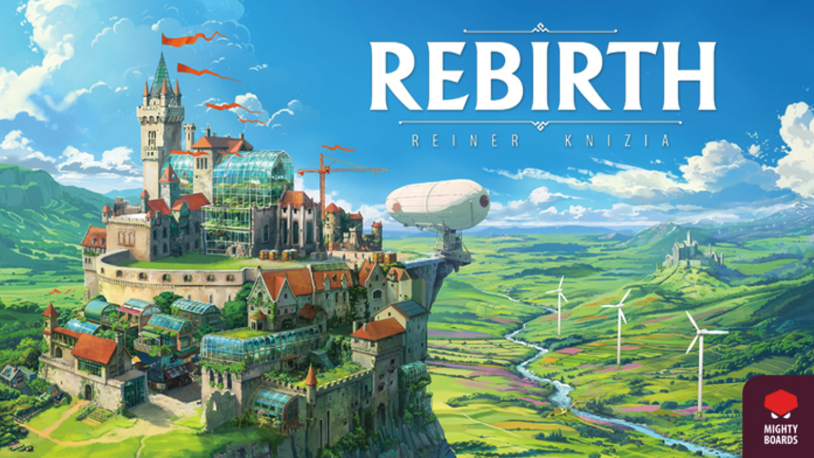
That emphasis on experience helped shape one of Mighty Boards' biggest successes: Rebirth, designed by legendary game designer Reiner Knizia.
How did Rebirth begin, and what made you feel like this was a game Mighty Boards needed to publish?
Gordon had interviewed Reiner Knizia for the book he was writing. Through that, we got in touch with Reiner's team, and they pitched us a number of games. At some point they showed us Rebirth, which was called Scotland at the time.
I still remember that moment. It was Gordon, Mark, and me on the call, and as soon as they described Scotland, all three of us looked at each other. We're workmates, but we're also friends, so sometimes we can communicate with just a look, and that look said: "Oh, this one's interesting."
We played it at Gordon's place. I remember thinking, "Guys, this is going to be a hit."
The game gives you enough strategy, but for some reason it also just makes you feel good. It makes you feel relaxed, and it makes you want to play again. You put in a small amount of effort to learn the rules, and in return you get a lot of satisfaction.
That's why we leaned into a cozy, solarpunk, hopeful view of the future, because it matches how the game makes you feel.
Rebirth went from a Kickstarter campaign to winning the Kennerspiel des Jahres. What was it like watching the game travel that far?
When Rebirth won the Kennerspiel des Jahres, we were incredulous. We had no idea it was going to happen.
I remember being 16, just getting into board games, looking at the Spiel des Jahres winners from 2007, 2008, and 2009 and thinking, "One day I'll win this award."
What I didn't know was how I'd feel when we actually won it. And I still don't, because I'm not sure it's really sunk in yet.
But deep down, I'd always felt that if there was a game that was going to get us there, Rebirth could be the one.
A new chapter for Rebirth
With Rebirth II, Mighty Boards is returning to the world that helped bring the studio international recognition. But the sequel isn't simply more of the same.
What will feel new in Rebirth II?
First off, hats off to Reiner for what he's managed to create here. He's taken the core systems of Rebirth and created a game that feels completely new while keeping the same core features and mechanics.
The original feels like it covers a passage of time of maybe two to ten years. Reiner has managed to create a game that feels like it spans 500 years.
If you were to compare Rebirth to a city builder, then Rebirth II, at least the primary map, feels like a civilization game in comparison, while keeping the same level of complexity and rules overhead.
In terms of the art and the quality of the components, we're going to maintain that, of course, and even bump it up in some ways. And we've designed this campaign so that people who want an easy, cheaper entry point can have one, while people who want everything a Kickstarter can offer have that option too.
Playing the long game
What do you understand about running a Kickstarter campaign now that you wish you'd known when you launched your first?
The first and most important thing is communicating, clearly and quickly, how a specific game is going to capture your imagination and offer a desirable fantasy.
Once a player is convinced they want the game, then they must decide whether they want it now, on Kickstarter. This often comes down to a value proposition. A good price or perhaps something exclusive.
We've generally been quite conservative with our campaigns. We don't create massive amounts of add-ons, because delivering on time and making sure we do things well is a higher priority.
Our ability to deliver, and on time, is what we value most. We're in it for the longer game.
Mighty Boards started as a side project, and now you're publishing internationally recognized games. What still feels ambitious to you?
I think the next step for us is to keep making games within the core genres that are universally attractive, but not just make them our way: also push boundaries within the genre and change the standard of what that genre can be.
We've learned how to make games our way. Now, how do we push the boundaries of what we can create within these genres? How do we make these experiences richer, more interesting, more surprising? How do we make people connect more, and feel more?
That's probably my personal ambition for the next step for Mighty Boards.
From its earliest campaigns to its award-winning releases, Mighty Boards has built its business around creating memorable experiences and connecting directly with the people who play its games. With Rebirth II, the studio is continuing to explore just how far that approach can go.
