
How Blockbuster Projects Benefit Smaller Projects
The data shows it: Blockbuster projects are, in fact, having a positive impact on the smaller projects around them.


One of the most common questions we hear at Kickstarter is: Are blockbuster projects sucking up all the dollars that could be going to smaller projects?
It’s an understandable concern.
You launch your project, and a multi-million dollar campaign goes live the next day. It can feel like you’re competing for the same attention and the same dollars.
But there’s another possibility. Do blockbuster projects create a “halo effect” that benefits the projects around them?
We looked at this question more than a decade ago and found:
Projects aren't fighting over a finite pool of Kickstarter dollars or backers. One project's backer isn't another project's loss. The backers that one project brings often end up backing other projects as well. Each project is not only promoting itself, but the Kickstarter ecosystem as a whole.
We recently re-visited the topic to see if the same conclusions hold true today and what, if anything, has changed. Below, we’ll dive into three major areas:
- How does backers’ pledging behavior change immediately in the wake of a blockbuster? It essentially doesn’t. There’s a minuscule uptick in dollars pledged and pledge cancellations, but the changes are so small they’re unlikely to meaningfully affect a typical campaign.
- How do blockbusters affect our backer network? Blockbuster campaigns bolster our backer network, driving a large number of new backers to Kickstarter who have gone on to pledge over $700M to non-Blockbuster campaigns.
- How do large projects affect our creator network? Record-setting projects help grow the platform, inspiring other creators to launch projects and bring their ideas to life. On average, a category sees over 100 new projects launched in the one-year period following a record-setter, compared to the prior year.
Let’s start by defining a “blockbuster” as a project that raises at least $2.5 million (USD). This roughly corresponds to the top 0.1% of successfully funded projects on the platform.
 Kickstarter
Backer Behavior in the Wake of a Blockbuster
Let’s examine if there’s any evidence of halo effects or resource competition on pledging behavior. Here, we looked at two metrics: the number of pledges and the dollar amount pledged to a campaign. For each, we tracked pledges made across the platform in the 7 days before and after each blockbuster [1].
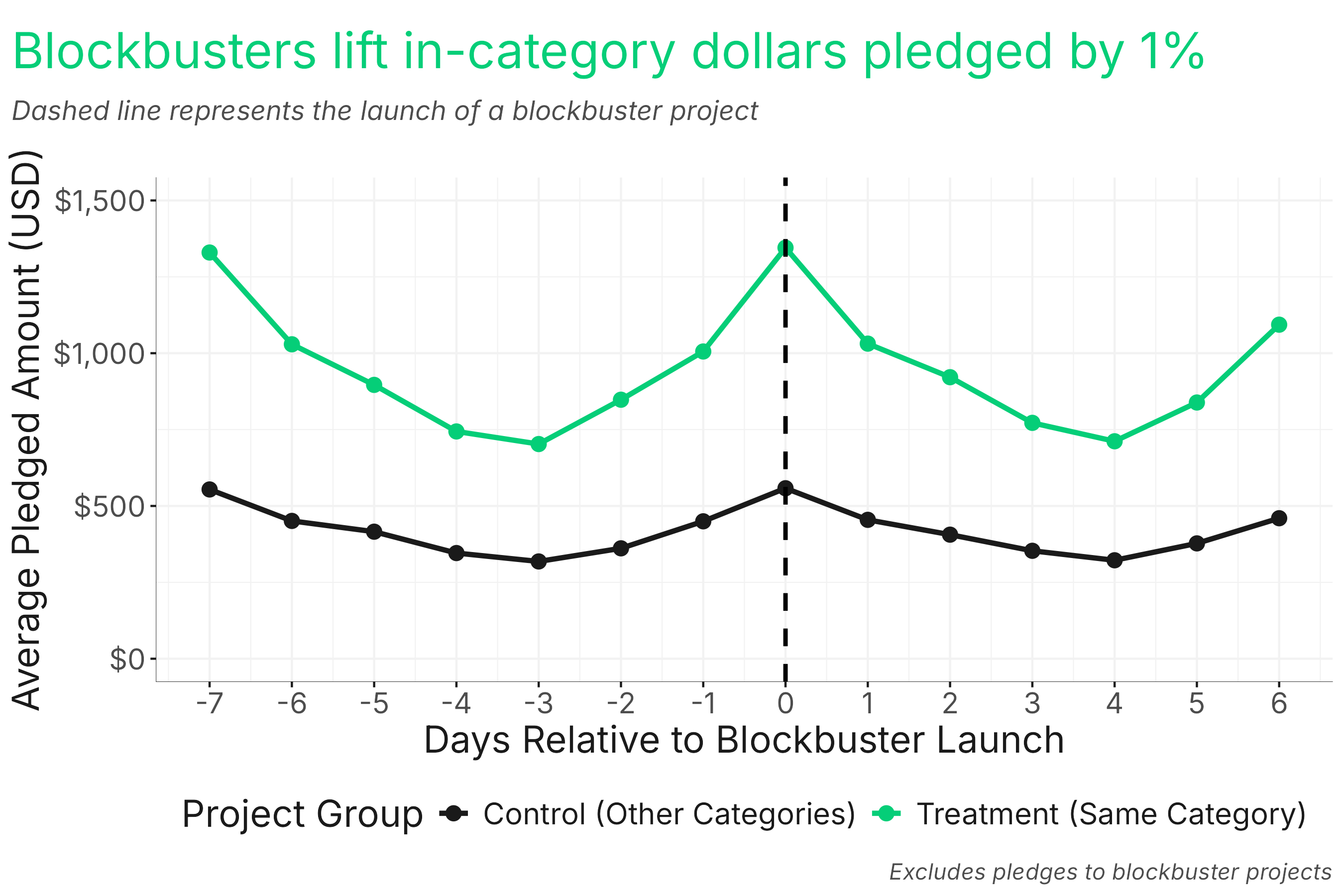
We compared how these pledge metrics changed following a blockbuster launch for a treatment group of projects in the exact same category as the blockbuster against a control group of projects in a different category.
The results: business as usual. Sharing the spotlight with a massive hit neither helps nor hurts other active campaigns in any meaningful way. We found no statistically significant difference in funding trends between our treatment and control groups. Even when looking at the raw numbers, the net differences in daily backings and pledge dollars were so small that they would be virtually unnoticeable to a creator actively running a campaign.
On average, when a project experiences a blockbuster launch in its own category, the average pledge amount ($USD) increases by 1.2%, and the average number of backings decreases by 0.3%, compared to an average project experiencing a blockbuster launch in a different category.
Academic researchers have reported similar effects. In a study from 2023, Wang, Yahn, and Hahn reported that blockbusters were associated with a 0.9% increase in pledge volume and a 0.3% increase in backers. They also found that blockbusters had long-term, positive effects on backer networks and pledging.
Pledge cancellations offer another metric to evaluate the existence of resource competition. Specifically, you might expect an uptick in canceled pledges to smaller campaigns following the launch of a blockbuster.
In reality, the number of cancellations to non-blockbuster projects is only 2% higher in the week following the launch of a blockbuster, compared to the week before.
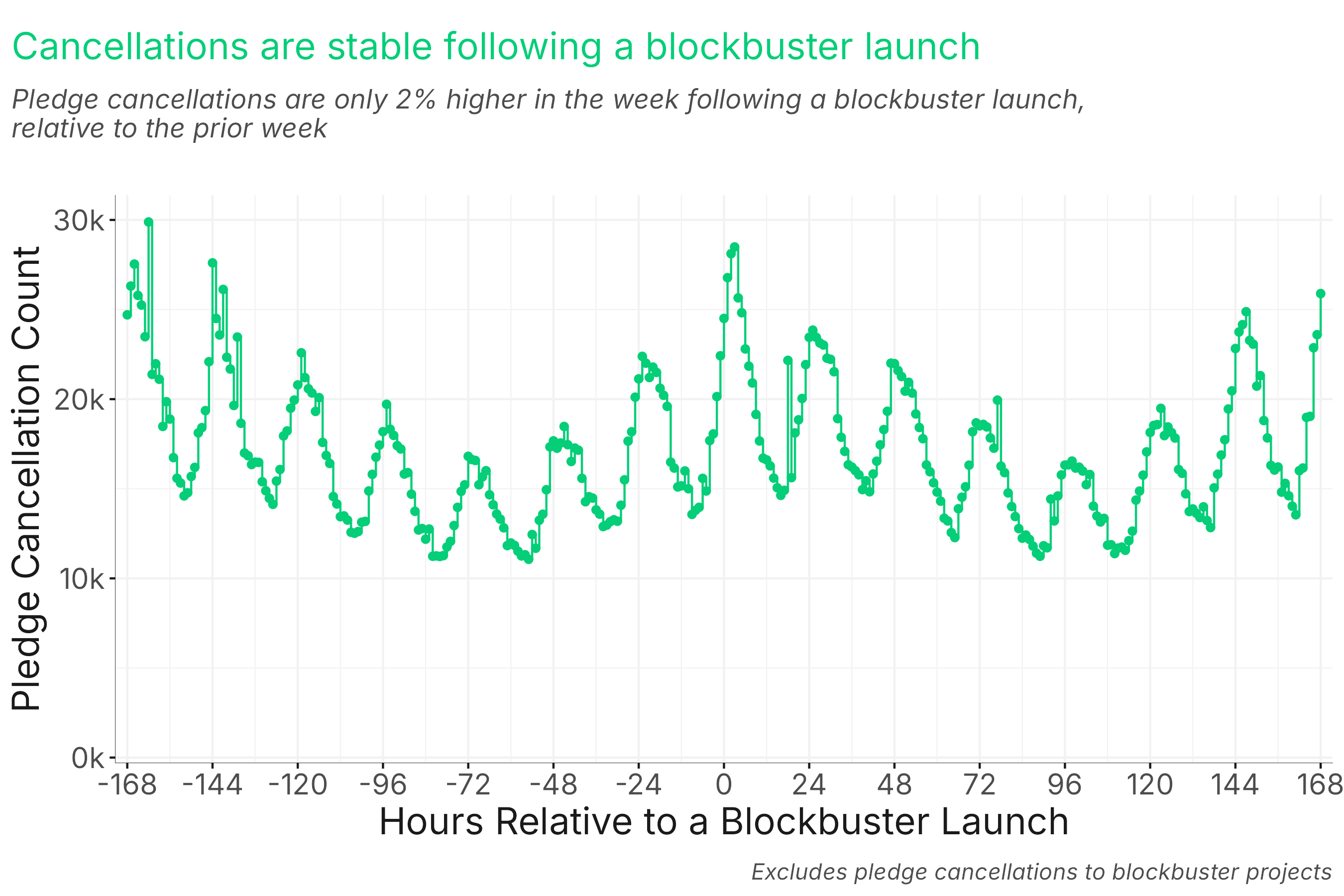
As a creator, you might experience an uptick in cancellations on the same day as a blockbuster launch. Why is that? Cancellations on Kickstarter generally show strong 24-hour and 7-day seasonality (in part because backers are not charged until a project is funded). We see a rise in cancellations in the early morning (Eastern Time), dropping to lows in the evening. On a weekly basis, we see cancellations peak on Tuesdays, declining over the rest of the week. These forms of seasonality exist even in weeks when a blockbuster doesn’t launch. Any midweek spike in cancellations you see is more likely to reflect general patterns of site activity, rather than blockbuster resource competition.
Blockbuster-Driven Backer Acquisition
In addition to the data from Wang et al., data in our 2012 blog post supported the role of blockbusters in strengthening our backer network. In the weeks following the launch of Double Fine Adventures, over 13,000 first-time backers who pledged to Double Fine Adventures went on to back another project [2].
Blockbusters drove an outsized number of newly acquired backers, many of whom are now among our most engaged. Although blockbusters made up only 0.1% of successful campaigns, they were responsible for 8% of newly acquired backers. Furthermore, backers who were brought to the platform by blockbusters helped bring more projects to life. They pledged to 2x as many campaigns and pledged 81% more money over the course of their account, compared to backers acquired by non-blockbuster campaigns. To date, backers brought to Kickstarter by blockbusters pledged over $700M USD to other campaigns.
Kickstarter
Project Launches
Notable projects also have long-term impacts on our creator community.
We looked at how big campaigns served as beacons for other creators [3].
We found that record setters are associated with growth in their category. In the one-year period following a record setter, we see an average of 119 more projects in that category than in the prior year. Record setters serve as a beacon for other creators, signaling that there is an audience for your next great idea.
Survey data from creators support this notion. In Project Build, creators can complete an optional Creator Demographics Survey. One question in the survey asks creators to identify their most important source of inspiration for starting their Kickstarter campaign. In a follow-up open-ended question, some of the most commonly referenced projects are record-setters, blockbusters, or those that have received critical acclaim (e.g., Hollow Knight). We estimate that Exploding Kittens was the primary source of inspiration for almost 3,000 projects, of which over 1,500 were launched, and over 600 were successfully funded.
Instead of harming smaller projects, these blockbuster projects result in category growth, creating a healthier space for the entire creative ecosystem, not just one individual creator. In fact, a single beacon project can be the catalyst for hundreds or even thousands of dreams to come true, bringing many new ideas to life.
[1]
To isolate the true impact, we leveraged a statistical model known as a stacked difference-in-differences model.
[2]
For this analysis, we used a more stringent definition of backer acquisition than was used in the 2012 blog post. To be counted as a "new acquisition," a user had to create a brand-new account and back the project while the campaign was actively live. In doing so, we exclude accounts with a long delay between user signup and the first pledge. These are cases where the first-backed project was unlikely to be the reason why the user created an account.
[3]
Here, we defined a big project differently. Instead of looking at blockbusters, we looked at projects that exceeded a funding record in their category. We’ll call these projects “record setters”. Given that in the first few years of Kickstarter, there were many record-setting projects, we restricted the record setters to projects that launched between January 2012 and April 2025.
